
You’ve heard about self reflection. You know it can reduce stress, improve emotional intelligence, and build empathy. You might have even read our previous post on the [4 Deep Benefits of Self Reflection].
But knowing why it works and knowing how to do self reflection are two different things.
The truth is, most people never start because they don’t have a clear, practical method. They think self reflection means sitting in silence for an hour, or writing pages in a journal, or being “good at meditating.”
That’s not true.
How to do self reflection is simpler than you think. It’s a set of repeatable practices that fit into your real life – even if you have only five minutes and a racing mind.
In this guide, I’ll walk you through four deep, actionable ways to practice self reflection. Each one stands alone. Pick the one that feels right for you. Master it. Then add another.
Let’s begin.
1. Allocate Time: The Non‑Negotiable Container
The first and most important step in how to do self reflection is simple: you must put it on your calendar.
Without dedicated time, reflection won’t happen. It will be pushed aside by emails, notifications, and the endless urgency of daily life.
How to do it (deep dive):
Choose a specific time of day.
Most people find evening works best – after work, before bed. But morning reflection (before checking your phone) is also powerful. The key is consistency.
Start with just five minutes.
Yes, five minutes. Set a timer. That’s all you need. When you allocate a tiny, non‑threatening block of time, you’re much more likely to actually do it.
Protect that time like a meeting with your boss.
Turn off notifications. Close the door. Tell your family: “For five minutes, I’m unavailable.” This signals to your brain that self reflection matters.
Why this matters:
Without allocated time, self reflection becomes a vague intention. With allocated time, it becomes a habit. And a habit of self reflection is one of the most valuable benefits of self reflection you can cultivate – because consistency creates transformation.
A real example:
A busy accountant set a recurring calendar invite: “Reflection – 5 min” at 9:30 PM. She put her phone on Do Not Disturb. The first week, she often stared at a blank page. By week two, she was writing naturally. Within a month, she couldn’t imagine skipping it.
Actionable prompt for tonight:
Open your calendar right now. Block 5 minutes for tomorrow evening. Label it “Self reflection.” That’s your first step in how to do self reflection.
2. Journaling: The Pen That Uncovers Your Mind
Journaling is the most common – and most misunderstood – method of self reflection. Many people think journaling means writing three pages of “dear diary” every morning. That’s one way, but it’s not the only way.
When you learn how to do self reflection through journaling, you’re not writing for an audience. You’re writing to clarify your own thoughts.
How to do it (deep dive):
Use prompts, not blank pages.
A blank page is intimidating. Instead, answer specific questions. Start with these three:
- What happened today that surprised me?
- What emotion did I feel most strongly, and why?
- What’s one thing I’d do differently if I could relive today?
Don’t worry about grammar or beauty.
Your journal is a dumpster for your mind, not a museum. Write in fragments. Swear if you want. Cross things out. The goal is honesty, not perfection.
Try bullet points.
Some people freeze when asked to write paragraphs. Bullet points work beautifully. Example:
- Felt anxious at 3pm – why?
- Saw boss’s name pop up.
- Remembered I made a mistake last week.
- Realisation: I’m not anxious about the future. I’m ashamed of the past.
Keep it short.
Five minutes. Three sentences. Even one word. Consistency matters more than length.

Why this matters:
Journaling forces you to externalise your thoughts. Thoughts that stay in your head can swirl and grow scary. Once they’re on paper, you can see them clearly. You can question them. You can let them go.
A real example:
A teacher felt angry every day after a specific class. She journaled: “Why angry?” She wrote: “Because students don’t listen.” Then: “Why does that make me angry?” Then: “Because I feel disrespected.” Then: “Is disrespect the same as not listening?” She realised her students weren’t being disrespectful – they were tired after lunch. She changed her teaching style. The anger vanished.
Actionable prompt for tonight:
Open a notes app or grab a notebook. Write: “One thing I felt today that I didn’t expect…” Then write whatever comes. No editing.
👉 That’s how to do self reflection with journaling.
3. Mindfulness: The Art of Observing Without Judging
Mindfulness and self reflection are close cousins. But while journaling looks backward, mindfulness helps you reflect in the moment.
Learning how to do self reflection through mindfulness means training yourself to notice your thoughts, feelings, and bodily sensations as they happen – without immediately reacting.
How to do it (deep dive):
Start with your breath.
Set a timer for two minutes. Close your eyes. Breathe normally. When your mind wanders (it will), gently bring your attention back to your breath. That’s mindfulness. It’s not about emptying your mind. It’s about noticing when it wanders.
Expand to body scans.
While sitting or lying down, slowly move your attention from the top of your head down to your toes. What do you feel? Tension? Warmth? Nothing at all? Just notice. Don’t change anything.
Use everyday triggers as mindfulness bells.
Every time you wash your hands, take three mindful breaths. Every time you sit in your car, notice your grip on the steering wheel. Every time you hear a notification, pause and notice your emotional reaction before checking.
Label your emotions.
When you feel a strong emotion, silently say: “Ah, that’s anger.” Or: “There’s anxiety.” Labelling creates a tiny distance between you and the feeling. That distance is the space where self reflection lives. Research shows that this “third person self-talk” can lessen stress and temper negative emotions .
Why this matters:
Most of us live on autopilot. We react to triggers without ever seeing them. Mindfulness trains you to notice the trigger before the reaction. That pause is where emotional intelligence is built – one of the core benefits of self reflection we explored earlier. Studies indicate that “turning inward” can strengthen our emotional intelligence , making it easier to cope with life’s challenges.
A real example:
A manager noticed he always snapped at his team after 2 PM. Through mindfulness, he started checking in with his body at 1:30 PM. He realised his shoulders were tight and his stomach was empty. He began eating a small snack at 1:30. The snapping stopped.
Actionable prompt for tonight:
Set a random alarm on your phone for sometime tomorrow afternoon. When it goes off, stop for 10 seconds. Ask: “What am I feeling right now – in my body and my mind?” Just notice. No judgment.
You might also enjoy our [7 Days Peaceful Mindset Challenge for Women]– a gentle week‑long mindfulness practice designed to fit into a busy schedule.
👉 That’s how to do self reflection through mindfulness.
4. Creative Expression: The Silent Voice of Your Inner World
Not everyone likes to write or sit still. That’s fine. How to do self reflection can also happen through art, music, movement, or any creative outlet.
Creative expression bypasses the logical, critical part of your brain. It lets your subconscious speak in symbols, colours, and sounds.
How to do it (deep dive):
Draw or doodle without a plan.
Get a piece of paper and a pen. Don’t think. Just draw whatever comes – shapes, lines, scribbles. After two minutes, look at what you drew. Ask: “What might this represent about how I feel?” There’s no wrong answer.
Use collage.
Cut images and words from old magazines. Glue them onto paper in any arrangement. The finished collage is a map of your inner world. Reflect on it: “What theme do I see? What surprises me?”
Try stream‑of‑consciousness writing (but differently).
Set a timer for three minutes. Write without stopping, without punctuation, without looking back. It can be gibberish. When you’re done, read it. You’ll often find hidden fears or desires buried in the noise.
Use music.
Create a playlist for your mood. Or listen to a piece of instrumental music and write down the images or memories that come to mind. Ask: “Why did that memory surface now?”
Move your body.
Put on a song and move however you want – no dance steps, no audience. Notice which parts of your body feel tight or loose. Notice which movements feel good and which feel forced. That’s your body reflecting.

Why this matters:
Creative expression is especially powerful for people who feel stuck with words. It’s also a way to access emotions that are pre‑verbal – the ones you can’t name because they’re too old or too deep. When you practice how to do self reflection creatively, you often uncover insights that journaling alone would miss.
A real example:
A lawyer who hated journaling tried doodling for five minutes each night. He drew the same shape – a box – over and over. After a week, he asked: “What’s the box?” He realised it represented his job, which felt confining. That insight led him to explore a career change.
Actionable prompt for tonight:
Take a blank sheet of paper. Draw your current mood as a colour, shape, or weather pattern (stormy, sunny, foggy). No artistic skill required. Then write one sentence: “This drawing tells me that I feel…”
If you enjoy visual self‑expression, you might love our post on [Art Therapy: A Creative Path to Healing and Well‑Being] .
👉 That’s how to do self reflection with creative expression.
Which Method Is Right for You?
You don’t need to do all four. In fact, trying to do everything at once is a fast path to quitting.
| If you… | Start with… |
|---|---|
| Are busy and want structure | Allocate Time – put 5 minutes on your calendar |
| Think best with words | Journaling – use the three prompts |
| Feel overwhelmed by thoughts | Mindfulness – start with two minutes of breath |
| Hate writing or sitting still | Creative Expression – doodle or move |
You can also combine them. For example, allocate five minutes (Method 1), then journal (Method 2), then end with one minute of mindful breathing (Method 3). Or use creative expression as a warm‑up before journaling.
How to Make Self Reflection a Lifelong Habit
Knowing how to do self reflection is one thing. Doing it consistently is another. Use these four strategies:
- Anchor it.
Attach reflection to an existing habit: after brushing teeth, after putting kids to bed, after your morning coffee. - Start ridiculously small.
One minute. One sentence. One doodle. Small wins build momentum. The EPALE platform also notes that setting a tiny habit of just 5–10 minutes, 3–5 times a week, is enough to see results . - Forgive yourself for missing days.
Missed a day? Don’t shame yourself. Just do it the next day. Perfection is the enemy of progress. - Celebrate the insight, not the effort.
When you learn something about yourself – even something uncomfortable – acknowledge it. That’s the real reward.
For a structured journey, explore our [Self‑Discovery and Growth] series – designed to help you build lasting self‑awareness.
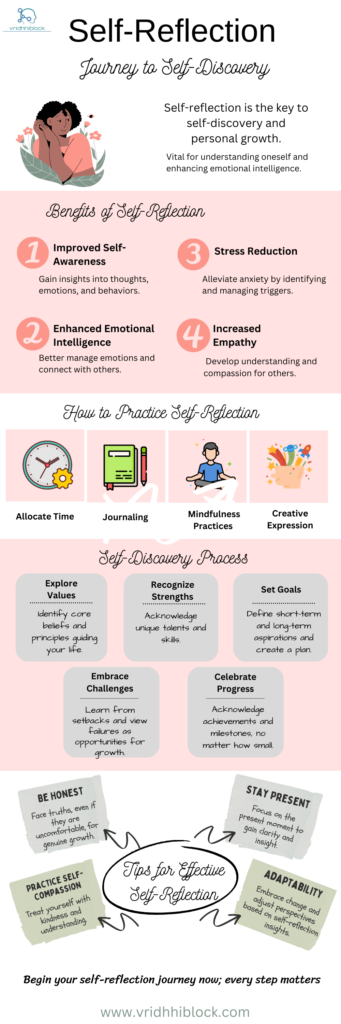
To help you stay on track, I’ve created this Self-Reflection Journey Map. Save this image to your phone or Pin it to your favorite board so you never have to guess your next step.”
Your First Step Tonight
You now have four deep, practical ways to practice self reflection. You know how to do self reflection without needing an hour, a silent retreat, or any special skill.
Here’s your exact first step:
- Choose one method from the four above.
- Set a timer for 5 minutes.
- Do it. Right now. Not tomorrow. Tonight.
Then do it again tomorrow night.
Within one week, you’ll understand why self reflection is the most underrated habit for a calmer, wiser, more connected life.
And if you ever forget why you’re doing this, come back to our earlier post on the [4 Deep Benefits of Self Reflection] . It will remind you.
Final Thought
You are not broken. You are not too busy. You are not “bad at reflection.”
You just haven’t been shown a way that works for you.
Now you have four.
Start with one. Be messy. Be inconsistent. But be curious.
Your inner world is waiting.
If this guide helped you, share it with one friend who feels stuck.
And before you go, leave a comment: What’s the one question you’ll ask yourself tonight?
Your answer might be exactly what someone else needs to read.