
After you learn how to practice self‑reflection and understand the benefits of self‑reflection, the next question is: What do you actually do with those insights?
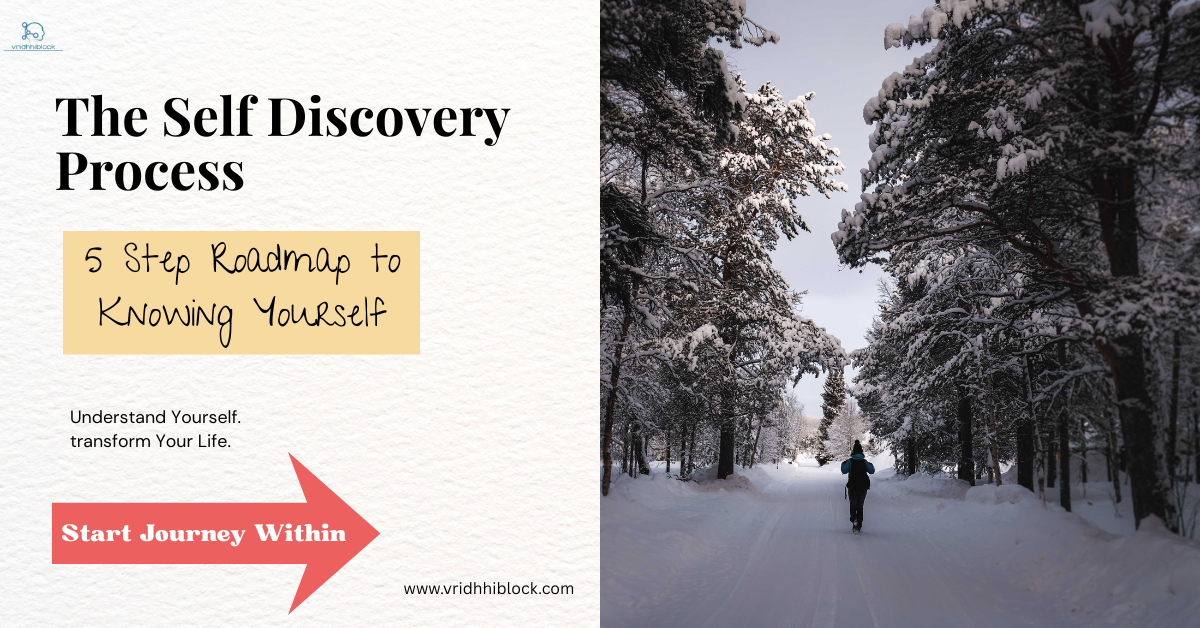
The Self‑Discovery Process turns reflection into action. It’s a structured journey that helps you uncover who you are, what you stand for, and where you want to go.
Let’s break down each of the five stages of this self-discovery process – with real examples, practical exercises, and common pitfalls to avoid.
1. Explore Your Values – Find Your Inner Compass
Your values are the core beliefs that shape your decisions, reactions, and sense of fulfillment. When you live aligned with your values, life feels meaningful. When you don’t, you feel restless or guilty – even if everything looks fine on paper.
A key first step in the self-discovery process is identifying what truly matters to you – not what your parents, culture, or social media told you should matter.
How to explore your values deeply:
- Do a “value recall” – Think of a moment you felt truly proud or happy. What value was honored? (e.g., honesty, creativity, family, security)
- Use a values list – Circle 10–15 from a standard list (e.g., integrity, growth, compassion, freedom). Then narrow to your top 5.
- Test them – For one week, make one small decision based on each top value. Notice how it feels.
Example: Maria thought “ambition” was her top value, but after reflection, she realized “connection” mattered more. She shifted from working 70‑hour weeks to prioritizing team lunches – and her happiness soared.
Pitfall to avoid:
Confusing inherited values (from parents or culture) with your own. Ask: “If no one was watching, would I still choose this?”
For a deeper values exercise, check out our Self‑Discovery and Growth series .
2. Recognize Your Strengths – Not Just Skills, But Natural Talents
Strengths are things you’re not only good at but also energized by. You can be skilled at something (e.g., Excel) but drained by it – that’s not a strength. A true strength leaves you feeling engaged and capable.
The self-discovery process asks you to look beyond your resume. What comes naturally to you that feels like effort to others?
According to the VIA Institute on Character , identifying and using your signature strengths can increase happiness, reduce depression, and improve work performance.

How to uncover your real strengths:
- Ask three people who know you well: “What do I do that seems effortless for me but hard for others?”
- Review past wins – Write down 5 successes. What abilities did you use in each? (e.g., problem‑solving, empathy, organization)
- Notice flow – When do you lose track of time because you’re so absorbed? That activity likely uses a strength.
Example: James thought his strength was “analysis” because he was an accountant. But he realized he felt most alive when mentoring new hires. His true strength was teaching – so he added coaching to his role.
Pitfall to avoid:
For more on using strengths in daily life, read our post on Unlock Your Potential: Professional Development for Career Growth
3. Set Goals – Turn Self‑Knowledge Into Direction
Values and strengths without goals are just self‑awareness. Goals give you a destination. But self‑discovery goals are different from typical to‑do lists – they come from within, not from pressure.
How to set self‑discovery‑driven goals:
- Use the “Value‑to‑Goal” method – For each core value, write one goal that honors it.
- Value: Health → Goal: Walk 20 min daily.
- Value: Learning → Goal: Read one book per month.
- Split into short‑term (1‑3 months) and long‑term (1‑5 years) – Long‑term gives direction; short‑term builds momentum.
- Make it “SMART‑er” – Specific, Measurable, Achievable, Relevant, Time‑bound – but add emotional relevance. Ask: “Why does this goal matter to me deeply?”
Example: Instead of “lose 10 lbs,” a self‑discovery goal: “Practice mindful eating 3x per week because I value self‑respect.”
Pitfall to avoid:
Setting goals based on what you should want (status, money, approval) rather than what truly fits your values. If a goal feels heavy, question it.
4. Embrace Challenges – Reframe Setbacks as Data
Challenges and failures are not the opposite of self‑discovery – they are the raw material. Every mistake reveals a hidden belief, a fear, or a gap in skill. The goal isn’t to avoid failure but to learn from it faster.
Psychologist Carol Dweck’s research on growth mindset (Harvard Business Review) shows that people who view challenges as opportunities to learn outperform those who see them as threats.
How to embrace challenges for growth:
- After a setback, ask 3 questions:
- What did this situation teach me about myself?
- What would I do differently next time?
- What strength can I use to recover?
- Keep a “failure resume” – List your biggest mistakes and next to each, write one lesson learned. Review it quarterly.
- Separate identity from event – Instead of “I am a failure,” say “I tried something and it didn’t work. Here’s what I learned.”
Example: Lena’s startup failed. Instead of hiding, she journaled: “I learned I’m better at product than sales. Next time, I’ll partner with a sales expert.” That insight led to her successful second venture.
Pitfall to avoid:
Ruminating without action. Reflection is only useful if it leads to a different choice next time. Set a timer – 10 minutes to feel, then 10 minutes to plan.
Our post on Emotional Resilience: Building Inner Strength offers more tools for navigating setbacks.
5. Celebrate Progress – Small Wins Rewire Your Brain
Most people skip this step. They achieve a goal and immediately move to the next without acknowledging the win. But celebrating progress is not fluff – it reinforces positive behavior and builds self‑trust.
The final stage of the self discovery process is often the most overlooked. Don’t make that mistake.

How to celebrate meaningfully:
- Create a “wins list” – Every Sunday, write down 3 small victories from the week (e.g., “spoke up in a meeting,” “went for a walk despite being tired”).
- Use micro‑rewards – After finishing a difficult task, take 5 minutes to do something you enjoy (stretch, listen to a song, text a friend).
- Share with someone – Tell a trusted person, “I’m proud that I…” Verbalizing doubles the impact.
Example: After 30 days of journaling, Tom bought himself a nice pen – not because he needed it, but to mark the habit. That small celebration kept him going for another six months.
Pitfall to avoid:
Dismissing progress as “not enough.” Even showing up for 5 minutes of reflection is progress. Comparison kills celebration – measure against your past self, not others.
For a structured celebration routine, try our Practicing Gratitude: Cultivating a Positive Mindset post
Putting It All Together – A Weekly Self‑Discovery Routine
| Day | Action |
|---|---|
| Sunday | Celebrate last week’s wins (10 min) |
| Monday | Review your top 3 values – plan one value‑aligned action (5 min) |
| Wednesday | Identify a strength you used that day (2 min) |
| Friday | Reflect on a challenge – write one lesson (10 min) |
| Saturday | Set one small goal for the coming week (5 min) |
Final Thought
The self‑discovery process is not a one‑time workshop. It’s a cycle – you explore values, recognize strengths, set goals, embrace challenges, and celebrate progress. Then you start over, a little wiser each time.
Your pillar page gave the map. This post gives the walking sticks.
👉 New to self‑reflection? Start with our guide on how to practice self‑reflection.
👉 Want to know why it matters? Read the benefits of self‑reflection.
Now take the first step.